
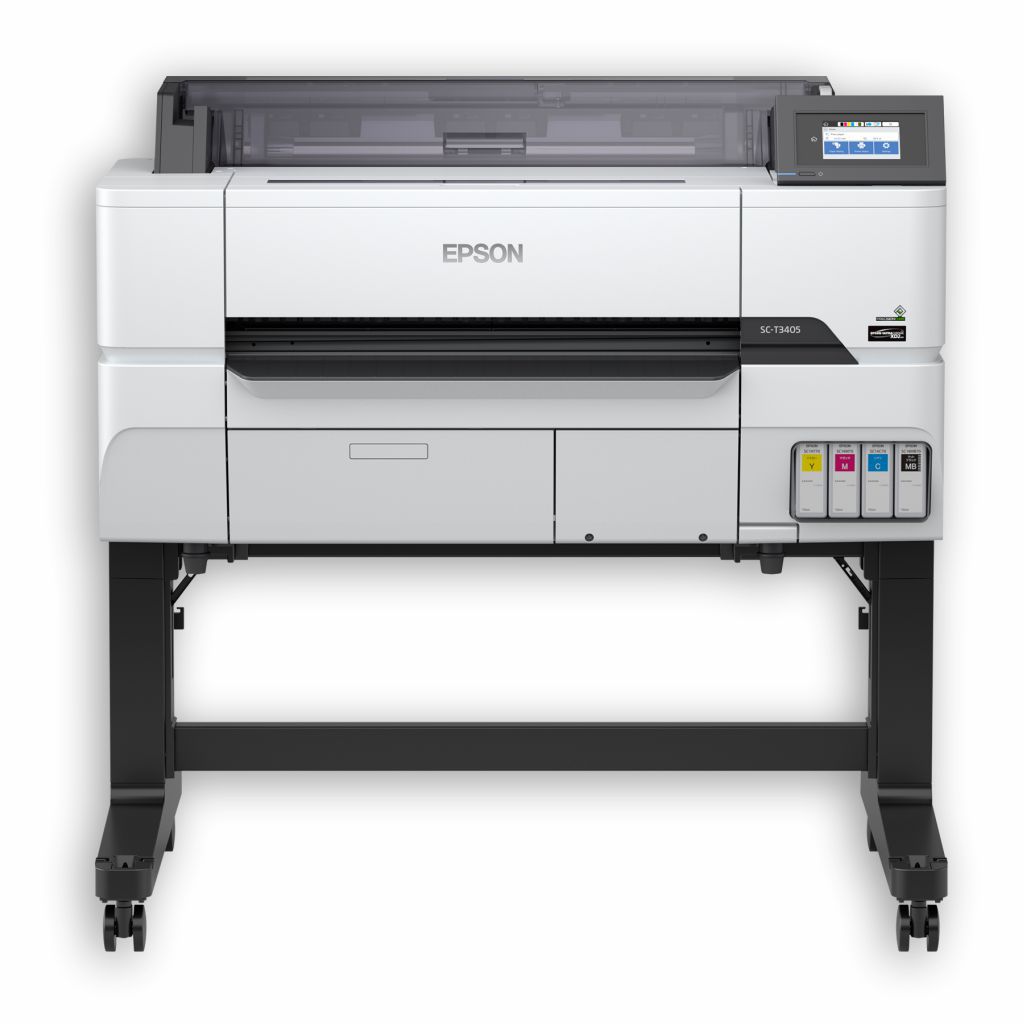
Printers for high quality inkjet film production

In our experience, the most suitable current printer series for high-quality film separations is the Epson SureColor T3405/5405. However, even these models are factory-configured with an increased platen gap and head alignment tolerances that are not precise enough for demanding film output.

The StudioRIP team modifies and calibrates these printers specifically for film production. With these adjustments, they are capable of producing high-quality separations up to 200 lpi.

For users requiring 44″ (1118 mm) width, we offer the Epson SureColor T7700D. StudioRIP is one of the very few RIPs capable of properly driving these newer models, which no longer support the ESC/P language used in earlier SureColor printers, and therefore require significantly more advanced control to achieve good output quality.

For those looking for an affordable A3+ solution, we offer the Epson EcoTank L11050 / ET-14100. These printers also require sensor calibration in order to reliably handle film media, which is performed by the StudioRIP team.

Models

• EPSON SureColor T3405: maximum 24″ (610 mm) film width
• EPSON SureColor T5405: maximum 36″ (914 mm) film width
• EPSON SureColor T7700D: maximum 44″ (1118 mm) film width
• EPSON EcoTank L11050 (ET-14100): maximum A3+ (329 mm) with film width

Features

• Sharp, stable halftone dots up to 200 lpi
• Black-on-white and white-on-black text with accurate thickness and clean edges
Adjustable quality–speed balance from maximum precision to high productivity
• Detection and compensation of defective (dead) nozzles
• True 2400 dpi output through direct nozzle-level control
• Increased throughput using lower resolutions or multi-channel configurations
DMax > 5.0 using StudioRIP ink
• Excellent water and scratch resistance using StudioRIP film

Technology

The printer defines the limits of print quality – the RIP determines how far you can push them. StudioRIP applies multiple layers of image processing specifically designed for inkjet film output:

• Dynamic Density Modulation: Produces compact, well-defined and perfectly rounded halftone dots across the entire tonal range by applying adaptive density control instead of uniform reduction
• Edge Enhancement: Increases local density on edges to achieve sharper contours, then compensates thickness for accurate geometry
• Ink Spread Compensation: Corrects the natural thickening caused by ink spread, ensuring precise line and text width
• RIP-based MicroWeaving: Bypasses the printer’s internal interlacing and directly controls the printhead. By reducing the active nozzle span (e.g. using only a fraction of the head width), both geometric and media feed-related errors are significantly reduced, resulting in dramatically improved print accuracy and sharpness. This level of control is not available in most RIPs and is a key factor in achieving high-quality inkjet film output.