
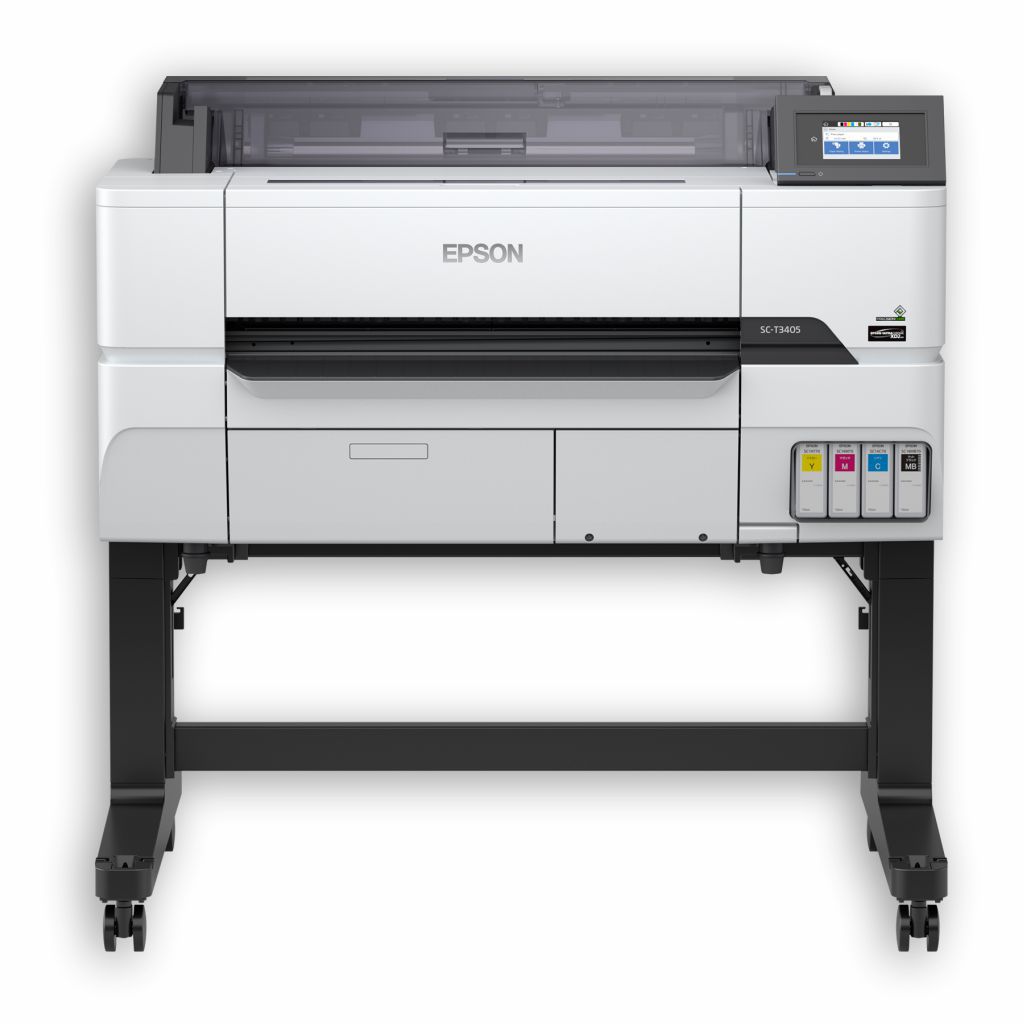
Printers for conventional offset plate production

Inkjet-based CTP systems are often perceived as suitable only for low-end applications, such as newspaper printing. This perception is not entirely unfounded, as many inkjet CTP solutions on the market are indeed limited in quality.

StudioRIP Droplet-to-Plate (DTP) systems represent a significant step forward in this field. In practice, they are commonly used for commercial printing applications, where consistent, high-quality output is required — typically up to 175 lpi color work.

The plates produced by the StudioRIP DTP system are standard aluminum CTCP plates, imaged with a conventional 175 lpi AM screening. The result is sharp, well-defined halftone dots, smooth and noise-free tints, and precise registration ensured by a pin-based positioning system.

Models

• StudioRIP DTP 24 (based on EPSON SureColor T3405): maximum 605×745 mm, recommended for 525×459 mm
• StudioRIP DTP 36 (based on EPSON SureColor T5405): maximum 1030×780 mm

Features

True 2400 dpi output through direct nozzle-level control
• Sharp, stable halftone dots up to 200 lpi (recommended: 175 lpi)
Conventional aluminum CTCP plates with optimized inkjet coating
Accurate registration ensured by a pin-based positioning system
• Typical commercial printing productivity: up to 10 plates/hour (400 × 510 mm, 175 lpi)
• Typical newspaper printing productivity: up to 10 plates/hour (1030 × 770 mm, 85 lpi)
• Black-on-white and white-on-black text with accurate thickness and clean edges
• Adjustable quality–speed balance from maximum precision to high productivity
• Automatic detection and compensation of defective (dead) nozzles
• Increased throughput using lower resolutions or multi-channel configurations

Technology – hardware

• An inkjet-receptive coating is applied to standard aluminum CTCP plates
• The EPSON printer images a high-density black mask onto this coating
• The plate is exposed with UV light (no vacuum required)
• The plate is processed in a dedicated processor developed for this workflow: the process starts with a pre-wash step that removes the ink and the coating, followed by conventional development, post-wash and drying
• Apart from the initial pre-wash stage, the process is identical to standard CTCP processing
• The only difference compared to traditional workflows is that the mask is created by inkjet instead of film
• The result is a fully conventional CTCP plate, with identical run lengths

Technology – software

The printer defines the limits of print quality – the RIP determines how far you can push them. StudioRIP applies multiple layers of image processing specifically designed for inkjet film output:

• Dynamic Density Modulation: Produces compact, well-defined and perfectly rounded halftone dots across the entire tonal range by applying adaptive density control instead of uniform reduction
• Edge Enhancement: Increases local density on edges to achieve sharper contours, then compensates thickness for accurate geometry
• Ink Spread Compensation: Corrects the natural thickening caused by ink spread, ensuring precise line and text width
• RIP-based MicroWeaving: Bypasses the printer’s internal interlacing and directly controls the printhead. By reducing the active nozzle span (e.g. using only a fraction of the head width), both geometric and media feed-related errors are significantly reduced, resulting in dramatically improved print accuracy and sharpness. This level of control is not available in most RIPs and is a key factor in achieving high-quality inkjet film output.